Share


Share
Presenting a compelling case for balancing commodity production with forest conservation, sustainable livelihoods, and the welfare of people at scale.

Riau is a crucial province for agricultural commodity production: approximately 2.5 million ha of oil palm and 2 million ha of pulp & paper. Indonesia is the world's largest producer of palm oil, and its smallholder oil palm plantations involve more than 2.3 million farmers. Riau is the largest palm-oil-producing province in Indonesia, and yet roughly 60% of the agricultural workforce is informal. Over 1.6 million smallholder farmers face challenges related to low productivity, poor seed stock, income volatility, and food insecurity.
Protected areas – such as nature reserves and national parks – remain under threat from continued exploitation by the palm oil and paper industries as well as smallholders and communities seeking to make a living. Whilst there are several commitments and efforts carried out by local governments, supported by central governments, nevertheless, complexity in the region warrants contribution and collaboration from various actors, including the work Earthworm Foundation does in the landscape.
Riau landscape is included in the Consumer Goods Forum – Forest Positive Coalition listing and is positioned to contribute to its Landscape Strategy. It is also featured on SourceUp, an online platform that connects buyers and stakeholders in agri-commodity supply chains with landscape and jurisdictional initiatives in production areas.
The project is systematically monitored and evaluated on a quarterly and an annual basis, using Earthworm’s Global Impact Framework Tool (GIFT).

2 Collective Action Plans have been implemented at the district level in Siak and Pelalawan. District governments are actively implementing Regional Action Plans for Sustainable Palm Oil, with sustainability considerations aligned with NDPE principles increasingly embedded into district policies and planning processes. Multi-stakeholder coordination platforms have been established, bringing together government, companies, and civil society to support more aligned and participatory land governance.

304,077 hectares of forest outside concessions are protected through 29 village regulations. 209,054 hectares of High Conservation Value (HCV) and High Carbon Stock (HCS) areas have been identified within concessions across 22 companies. Village-level land-use planning and governance mechanisms have been established to support long-term forest protection and improved local stewardship.

3,769 farmers have been trained in Good Agricultural Practices (GAP) across the Riau landscape. 2,538 farmers have been supported in oil palm replanting, covering approximately 6,190 hectares. A 2024 study shows that 93.5% of trained farmers have adopted GAP, contributing to improved farm management and productivity. Livelihood diversification activities have been implemented to support more resilient and diversified income sources for farming communities.

10 communities have developed conflict resolution systems, benefiting approximately 4,000 people. 2 communities have strengthened their land tenure security, while additional villages are engaged in ongoing tenure processes, reaching 339 people and covering 1,186 hectares. Participatory mapping and land tenure assessments have supported communities in clarifying land claims and engaging with formal recognition processes.

2,519 workers have benefited from improved labour practices across 8 companies. Approximately 14,000 workers and their family members have been indirectly impacted through improved labour conditions, training, and awareness activities. Labour working groups have been established to strengthen dialogue between government, companies, and civil society on labour rights and working conditions.
Civil society
Engaging local actors, providing capacity building and training and facilitating multi-stakeholder collaboration.
Government
Providing the human resources and operational framework to support the protection of forests and protected areas.
The private sector
Implementing NDPE commitments in their supply chains & participating in landscape-level transformation activities.
Associated Funders
Donor
Field Partners

Landscape Lead
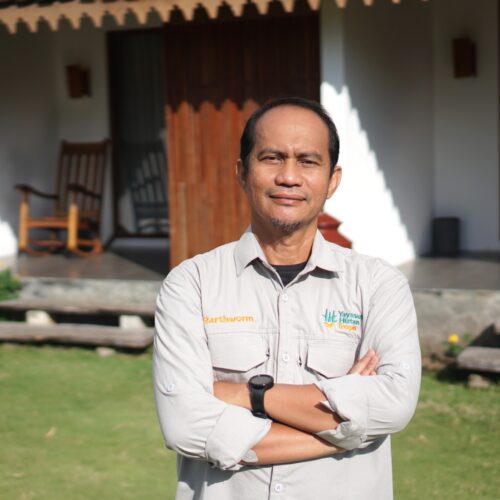
Riau Landscape Manager

Social and Engagement Manager

Livelihood Manager

Forest and Carbon Coordinator

Forest and Carbon Manager

Livelihood Coordinator
Beyond our on-the-ground field teams, our technical specialists in Indonesia play a pivotal role in supporting and advancing the landscape initiatives.

Riau is one of the key ecosystems where Earthworm Foundation works through its landscapes approach.
Click on the icons to learn more about Earthworm's work on the commodity:


